It turns out that writing a eulogy really sucks

Over the last few years I have dedicated thousands of words in various places and, probably, hours of recorded rantings to raging against the machine of Generative AI. In text and image generation, in chatbots that pretend to be your favorite character, and in the more insidious ones that pretend to be your friend. But for all that I have said and screamed and cried about it, there are so many pieces of this deep anger and sadness that I really just cannot figure out how to put into words.
I don’t know how to convince people that art matters. Broader than that, I don’t know how to convince people that art is more than what hangs in museums, and that they’re exposed to and impacted by art in so many forms every single day. I don’t know how to explain to people that everything around us becoming more and more manufactured is a bad thing. There are things about the human experience remaining human that feel so foundational that I don’t actually know how to articulate it, I just know that I feel it. And maybe that’s a weakness of my argument, but I think it’s also the point.
I had to write my dad’s eulogy last week. And a few days ago I stood in front of nearly a hundred of his friends and our family to read it at his memorial.
ToastPal, EulogyExpert, the extremely ironically named Originality.AI, DeathNote.AI, Tafofile, Trustworthy, FuneralSpeechAI, quickfuneral, ChatGPT, Grammarly, these are all services that come up on the first page of results if you search for an AI generator for a eulogy.
In seconds you can prompt a language model “designed to assist individuals in crafting heartfelt and meaningful eulogies.” Every one of these boasts a eulogy that is personalized and heartfelt. The word heartfelt comes up quite a lot for a thing without a heart to feel.
I am not religious. I don’t believe in an afterlife, I don’t believe my father is “here” in any way, I don’t believe he has the capacity to be offended, and yet the idea of farming out a handful of sentences for him to be remembered by to a machine operated by the worst kind of tech bros feels like the most disrespectful thing you could do to a person when they are not here to defend themself from it.
And maybe my dad wouldn’t care, but I do. And funerals aren’t for the dead. They’re for the rest of us left behind.
AI promises you a world free of discomfort. Don’t worry about not knowing what to say in that email to your boss or a client. Don’t worry about not knowing how to interpret that book you have to write an essay on. Don’t worry about not quite understanding the latest news headline. Don’t worry about not feeling like you have an artistic eye. Don’t worry about not being exceptional at your hobbies. Don’t worry about having to learn something. Don’t worry about not having the perfect style. Don’t worry about not looking how you think you’re supposed to. Don’t worry about not having friends. Don’t worry about not knowing what to say at a funeral. Don’t worry about feeling grief.
Don’t worry about feeling anything at all.
AI can promise you a “stress-free eulogy writing experience,” but I think writing a eulogy should come with some stress. To be a person is to feel discomfort. If you don’t know what to say, that’s the thing that you say. The eulogy I wrote for my father starts with me saying that none of us knew how to write a eulogy. The words “I do not have the words” mean so much more than any chatbot you might use because you think it makes you sound perfect.
AI doesn’t want to just strip the difficulties out of your life, it wants to strip you of your humanity.
The eulogy I wrote for my dad is barely 400 words. I drove to his house and I sat with his wife and my sister and I looked at a blinking cursor and thought about what the fuck I was supposed to say about my dead father, decades before any of us thought we would be in this position.
This blog post is already almost twice as long as what I wrote, but the length doesn’t matter. I sat there and thought about what I was writing, and who I was writing it for, and what I needed it to accomplish. I thought about sitting in a room in front of dozens of his friends who I don’t know and family members I haven’t seen in decades but who have lost a piece of themselves as well, and I thought about inevitably reliving the worst month of my life spent in a hospital room watching him die, and I thought about how I wanted to speak something into that room because it felt like the only useful thing I could do, but how I didn’t want to put too much of myself in it because I don’t want to give a room full of strangers the relationship I had with him.
So I poured out a few hundred words that felt real and true and felt like they were from all of us and not just me and felt like they were for everyone in that room. And I cried. I cried writing it. I cried while I practiced reading it alone in my apartment. I cried while I practiced it in the family room of the venue where we hosted his funeral, with a lit up sign that read BEST DAY EVER hanging on the wall next to me (they usually host weddings. Made for some not great funeral decor but really fantastic catering.). And I cried when I read it into a microphone.
And it sucked! It was deeply uncomfortable to write and to read, but that’s what being a person is. We live and we love and we hurt and we have extremely complicated feelings about it all and all of it is equally important.
Some of these AI eulogy writers sound like they give you some kind of questionnaire to fill out - I can’t be sure, I didn’t click on any of them - and I can’t get over how soulless that is. What kind of questionnaire can boil a person down into an easy few paragraphs to be remembered by?
Before I deleted it, there was a long aside here about how my dad and I connected over music my whole life, but, much as I felt with his eulogy, I don’t want to give strangers the relationship I had with him in all its ups and downs. So you'll have to pretend there was something deep and meaningful here.
What the fuck is AI going to do with that? I cannot imagine handing that kind of pain off to a predictive text machine to spit out some kind of pseudo-remembrance so that I can feel like I look like I’m grieving properly.
Maybe what I had to say at my dad’s funeral was too short. Maybe someone in that room heard me read it and thought I wasn’t upset enough or didn’t do enough or I don’t care enough or I’m a bad daughter or a bad person or a disappointment, but at least it was real. It was me and it was my pain and they were my feelings and my words and my voice.
AI is a performance of humanity. I can understand, I think, the desire for the perfect performance. Something I struggled with in thinking about what to say was the idea that a eulogy is sort of inherently performative. One of the things I dreaded most about the funeral was that it felt like I was supposed to perform grief and people would be looking at me and would they think that I was performing it in the right way? But also…fuck ‘em. I mean, not really. People were fine and, as always, no one is really looking at us the way we feel like they are, but theoretically if anyone were thinking such a thing…fuck ‘em. He was my father, not theirs, so who fucking cares? Certainly not me. Grief does not need to be performed to a standard. There are no necessary beats to hit [start crying here] [voice cracks there] and at the end of the day all that mattered to me was that I was there for the people who need me there.
So what if I stand up for a eulogy and sit down way faster than anyone anticipates. Who wants a long, drawn out funeral anyway?
AI is designed to insulate you from that kind of discomfort. The discomfort of not knowing. Of feeling like you might do or say the wrong thing or of having nothing to say at all. But life is uncomfortable. The discomfort is how we grow. Sometimes. Or maybe it’s not, and the discomfort is simply for the sake of discomfort because that’s what comes with being alive.
I’ve officially decided I hate funerals. I mean, who doesn’t? But as a whole concept I really hate funerals. I was uncomfortable about the funeral for weeks and the last couple days leading up to it I was physically ill about it. I wasn’t eating much, I couldn’t seem to sleep solidly through the night, and I was constantly thinking about being in a room full of mostly people I don’t know and performing grief, but that’s what being a person means for me. I have an anxiety disorder, so being alive comes with a lot of that kind of feeling.
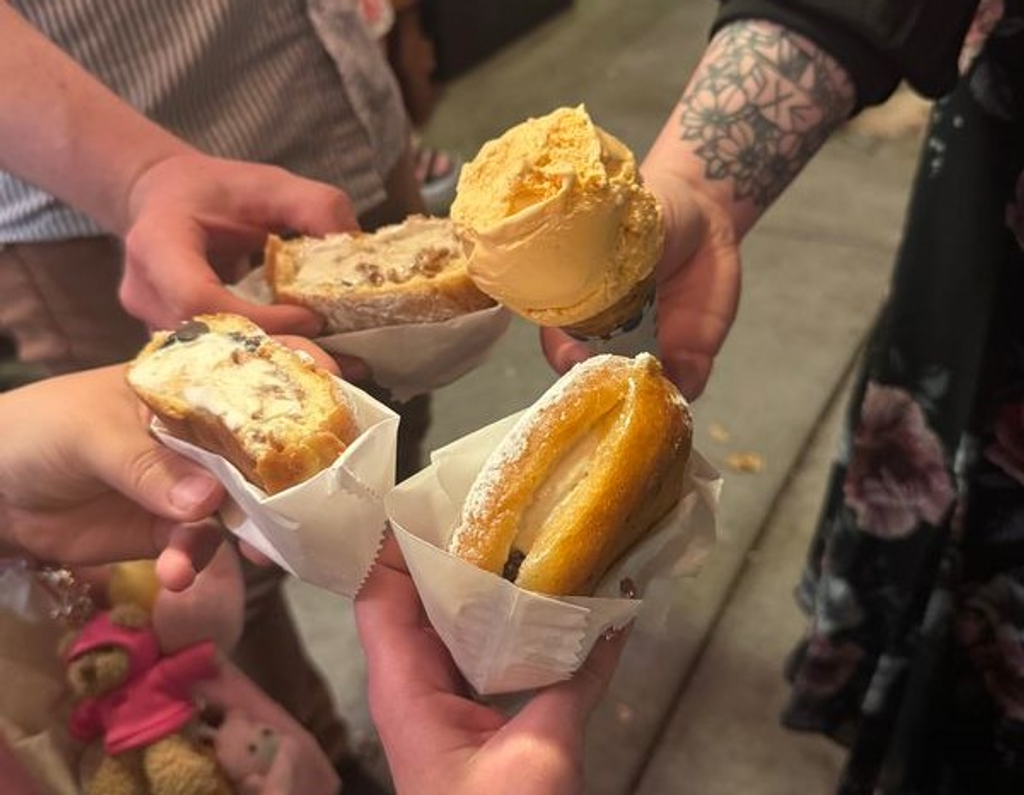
But I was also thinking about my friends who would be driving hours to come to the funeral with me because they knew it was going to be really hard for me, and about my friends thousands of miles away texting me to check in because they knew I was having a hard time, and about the ice cream I was going to get after the funeral. (I’m so fucking serious about this, I actually couldn’t stop thinking about the ice cream was going to get. It was my reward for making it through and it’s the image at the top of this blog post. Warm, soft donuts with thick ice cream sandwiched in between. Incredible.)
Even as I sit here having written more than 4x what I wrote for my own father’s eulogy, I still can’t really settle on the words that express, in very simple terms, what I feel AI is distinctly harming. But it’s robbing us all of this. This is what it means to be a person. Awkward and unpleasant and a grammatical nightmare. When everything in our lives is increasingly manufactured, it feels sometimes like all we have left are our own feelings, even the bad ones. So why on Earth should we give this up?
I’ll take the stressful approach to writing a eulogy, thanks.
Comments